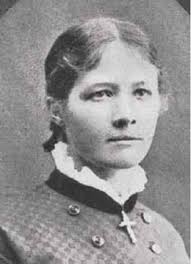
 Ida Bindschedler (July 6, 1854 – June 28, 1919) was a celebrated Swiss children's author and educator whose regional stories achieved immense popularity in Switzerland,
rivaling the legacy of Johanna Spyri’s classic Heidi.
Ida Bindschedler (July 6, 1854 – June 28, 1919) was a celebrated Swiss children's author and educator whose regional stories achieved immense popularity in Switzerland,
rivaling the legacy of Johanna Spyri’s classic Heidi.Partner Emma Wachter
Queer Places:
Weinpl. 7, 8001 Zürich, Switzerland
Villa Bellerive (now ZAZ Bellerive - Zentrum Architektur Zürich), Höschgasse 3, 8008 Zürich, Switzerland
Ida Bindschedler (July 6, 1854 – June 28, 1919) was a celebrated Swiss children's author and educator whose regional stories achieved immense popularity in Switzerland,
rivaling the legacy of Johanna Spyri’s classic Heidi.
Born in Zurich, Switzerland, she was the daughter of the cotton merchant Friedrich Rudolf Bindschedler and Anna Tauber. During her youth, her family spent their summers at the Villa Bellerive on the shores of Lake Zurich, a picturesque setting that profoundly influenced her later literary work and served as the direct inspiration for the fictional locations in her books.
Bindschedler pursued a career in education, training as a teacher under the mentorship of the prominent writer and journalist Joseph Viktor Widmann. Widmann recognized her pedagogical talents and subsequently recommended her for a teaching position at a private girls' school in Zurich. She dedicated 24 years of her life to this institution, steadily advancing from a primary school teacher to a secondary school educator and briefly teaching in Paris as part of her professional development. Her workload was exceptionally demanding, often committing around 40 hours a week to classroom instruction and supplementary lessons. She ultimately stepped down from her educational career due to a developing heart condition.
Throughout her personal and domestic life, Bindschedler shared a close household with her sister, Pauline, until 1897. When Ida temporarily relocated to Augsburg, Germany, in 1897 to live with her friend Emma Wachter, Pauline remained behind in Zurich. It was during this period living alongside Wachter in Augsburg that Ida began writing the children's books that would make her famous, publishing her debut work, "The Turnach Children in Summer" (Die Turnachkinder im Sommer), in 1907. This intimate partnership with Wachter places Bindschedler within the broader historical network of independent, educated women in late-nineteenth and early-twentieth-century Switzerland who forged profound, lifelong bonds outside of traditional heterosexual marriage structures. While historical documentation surrounding personal intimacies of Swiss women writers from this era is often sparse or guarded against contemporary censorship, scholars examining the biographical networks of pioneering female educators and authors in Zurich frequently highlight these female-centered partnerships as vital emotional and social frameworks that sustained their personal lives and creative endeavors.
Following subsequent changes in living arrangements and Ida's eventual death on June 28, 1919, at the age of 64, her sister Pauline carefully managed her literary estate. Pauline oversaw the preservation of Ida's manuscripts and directed the posthumous publication of her final novel, "Die Leuenhofer." Bindschedler's books struck a powerful chord with Swiss readers, capturing domestic and familial life with warmth and authenticity, and they attained a level of commercial and cultural success in Switzerland comparable to Spyri's Heidi. Many of her narratives were anchored in Seeweid, a fictionalized version of the Riesbach district in Zurich where she had deep personal ties, and the city of Zurich honored her enduring literary contributions by naming a street, the Bindschedlerstrasse, in the Riesbach district after her.
References:
Support this project
This website is a passion project researched, developed, and funded entirely by me. If you find the content valuable and would like to help support the ongoing research and hosting costs, any contribution is deeply appreciated.
Thank you for keeping this independent resource alive!
My books on Amazon: Elisa Rolle's books